Eleven years ago I started a tiny software business because I could code and most people couldn't. This year, one chart suggests that era could be ending.
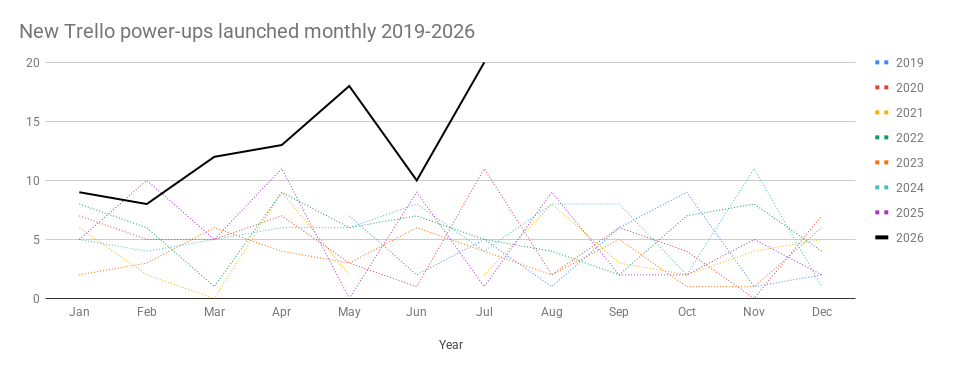
The chart shows new Trello Power-Ups launched in the previous month since 2019. We've published stats on the Power-Up directory for years over at Blue Cat Reports, and for most of that time it was a very boring hobby: seven thin dotted lines, each bouncing between zero and eleven new Power-Ups a month, averaging about five, with no trend you could honestly draw through seven years of data. Then there's 2026, the bold line, which has spent the whole year climbing away from the pack. Back of the envelope, the directory has gained a typical year and a half's worth of launches in six months.
Could it be Trello itself? The "new Trello" relaunch in 2025 might be viewed as the ecosystem's first real burst of energy in years, but I can tell you from my own experience that Trello Power-Up owners are seeing fewer and fewer signups recently, not more. Trello has been increasingly sidelined by Atlassian in recent years. And it isn't that Atlassian flung the doors open, every one of those new Power-Ups still passed a manual review and a signed developer agreement. But the same surge is appearing everywhere at once: App Store submissions jumped by more than half last year, Google says Chrome extension developer registrations doubled, and Shopify's app count reportedly grew by half. When every pond rises at the same time, it isn't the pond. It's raining. The rain is AI coding tools.
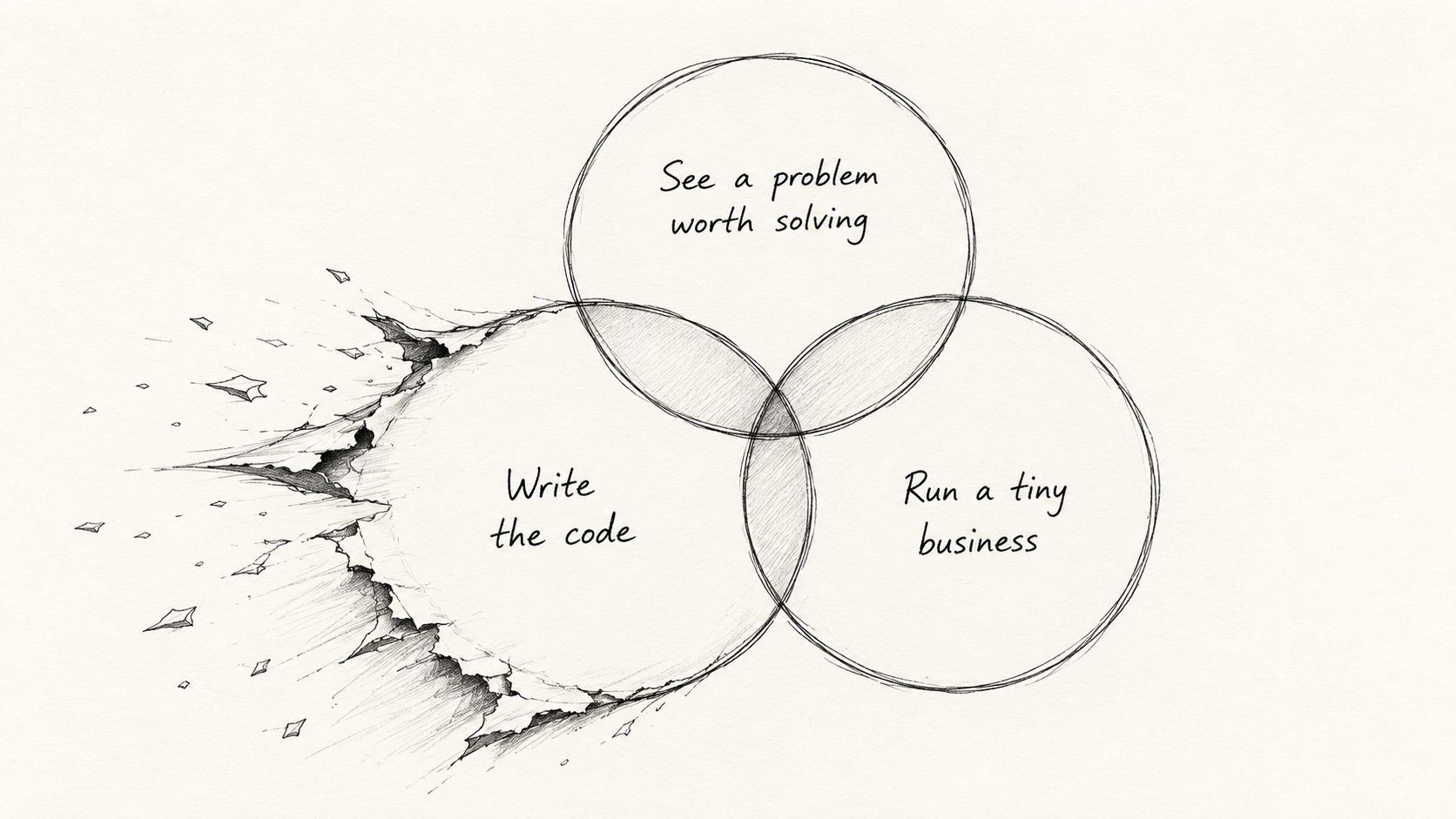
For eleven years my working life has lived inside a small Venn diagram. Three circles:
- you can see a problem worth solving in some unglamorous niche
- You can write the code to fix it
- You have the temperament to run a tiny business (answering the support inbox, doing your own VAT return, going for a swim on a Tuesday afternoon because there's nobody to tell you not to)
It's also what made the community so lovely. Bootstrapping in the 2010s meant finding the other people whose odd Venn diagrams had led them somewhere similar: the podcasts, the meetups, the person making a comfortable living from scheduling software for dog groomers who'd cheerfully tell you everything they knew. Nobody was going to be a billionaire. Everybody was going to be fine.
Everyone in that community, me included, said some version of the same thing: the code is the easy part. Marketing is the hard part. Distribution is the hard part. All true, and all said by people standing safely on the far side of a wall we'd stopped noticing. "The code is the easy part" is the sort of thing you say when you can code. For everyone who couldn't, it wasn't the easy part; it was the impassable part. The wall was doing quiet, unglamorous work on our behalf the whole time we were busy downplaying it.
Because what the "can code" circle actually did was keep niches sleepy. The accountant who saw the gap couldn't build the fix. The developer who could build the fix never saw the gap. Competition was limited to the few people who could do both, which in most niches rounded down to almost nobody. The margins in these little businesses were never payment for cleverness. They were payment for scarcity.
Here's the thing. That circle has swallowed everyone, it's just most of them don't realise it yet. The project manager irritated by a missing report no longer needs to find a developer, or spend her evenings becoming one. She describes the thing and the thing appears. And a circle that contains everyone does no work in a Venn diagram. It's just the page.
I'm still hopeful. Right now plenty remains scarce: distribution, trust, depth in a niche, but a lot of that is going to disappear fast. The door hasn't closed. It's been taken off its hinges, and everyone can walk through now. So yes we'll see an explosion of new apps but we'll also see more niche SaaS apps in places we couldn't reach before. That's probably a good thing; more people building businesses, more people benefitting from them, and some different people coming to bootstrapper events!
P.S. If you're wondering why an essay about bootstrapping lives on a grant-funding website: Hinchilla (the site you're reading, funder search and grant writing tools for UK charities) is my current attempt at exactly this kind of nice little niche business. The Venn diagram may be dying, but I'm not done standing in it.